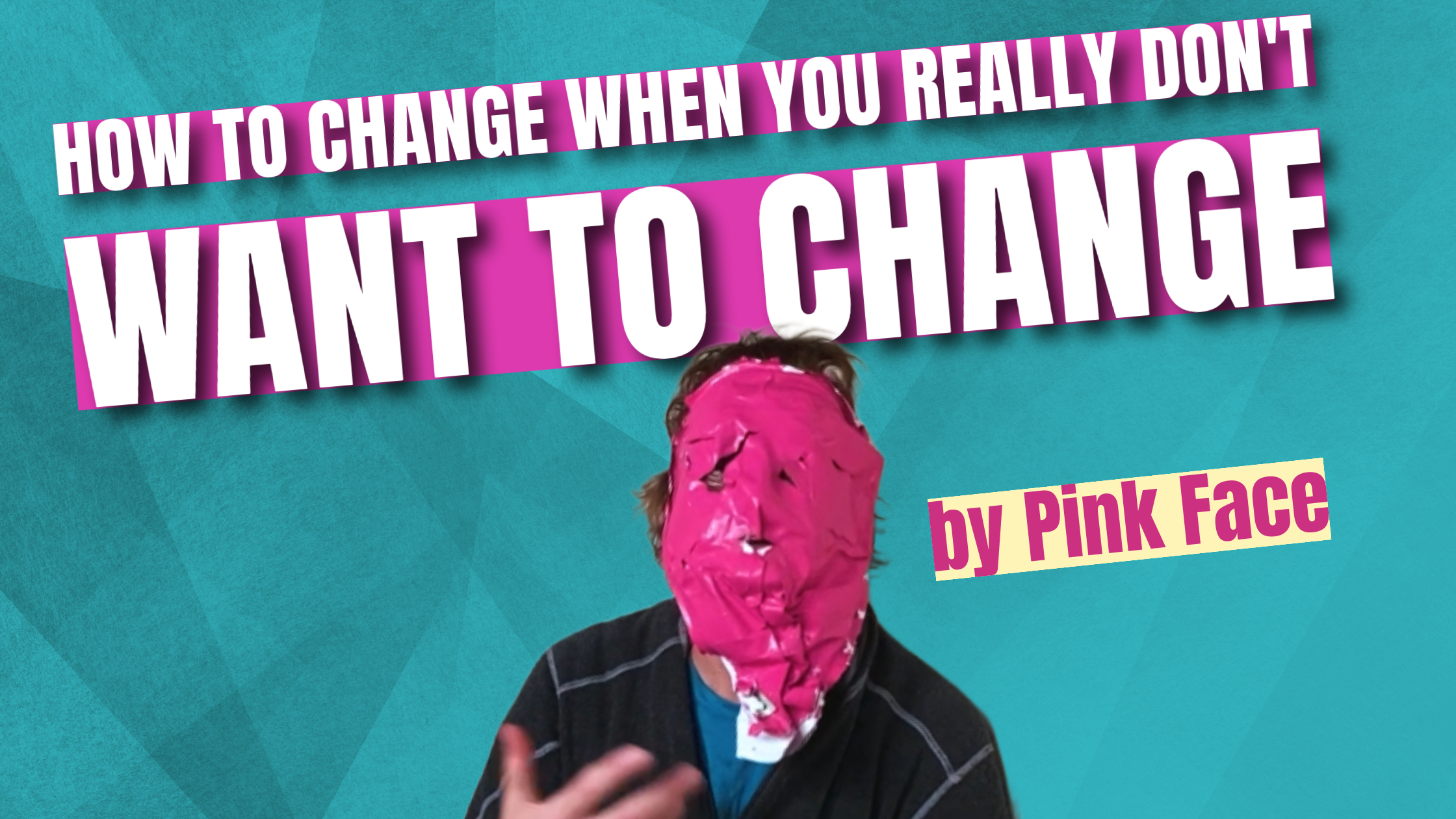
Change is HARD. I don’t care how strong-headed a person is, few persons can change. For some reason, I feel like saying “change is hard” one more time: Change is HARD. Well, look now, I think my obsessive-compulsive disorder must be getting activated because I now want to say it again: Change is HARD. Change is HARD. Change is HARD. Okay, that is enough, but I now do have one final urge to say it again, but I’m going to resist this compulsion and not say “change is HARD” one last time.
See?
I just changed from needing to obsessively repeat “change is HARD” to getting myself not to repeat “change is HARD”. I didn’t want to change because change is HARD, yet I did change even though change is HARD.
And, despite change being hard, you can change, even though it’s hard, by following my expert advice!
Let’s get started, shall we?
Acknowledge the resistance to change
Start by admitting to yourself that change is HARD. That humans just have a natural resistance to change.
Why exactly is change so HARD? I’ll tell you why change is so HARD right now.
Comfort Zones & The Brain’s Resistance to Discomfort
Efficiency – The brain is wired for efficiency, preferring familiar patterns and routines because they require less energy. On the deepest level the brain is always trying to conserve energy because it doesn’t want the body to starve to death. If the body dies, then the brain will croak along with it. The brain doesn’t want to be deceased, the brain wants to live, the brain would live for all eternity if it could, so the brain is always looking out for its good buddy, the body, that provides it with a nurturing home.
If change is TOO FAST, the body could quickly run out of calories before the brain could tell the body to eat more food to obtain more calories to fuel the rapid change and then, sadly, the brain perishes.
Stress – Change creates uncertainty which often creates stress
People don’t like stress. Stress feels bad. People want to feel happy and comfortable with a sense of well-being, and stress is the opposite of that. Stress makes you feel sad and bad and mad and… not glad.
Comfort zones – We all get into zones of comfort and even if they’re not always healthy, the familiarity does keep us feeling content. Change pushes us out of our comfort zones, and we don’t like it. Not one bit. No, siree, bob.
Identity & Self-Concept
Many of our habits and behaviors are tied to how we see ourselves. If we make a change, our identity could be threatened.
Let me provide a personal example. I like to smoke cigarettes. Oh, side note, did you know cigarettes used to be called FAGS? That’s funny, huh? LOL.
I don’t like to smoke fags just because I’m hooked on nicotine which is the addictive chemical in tobacco.
It’s because smoking fags makes me look cool. I don’t know why exactly, but I guess this burning white stick dangling from my parted lips looks like, I don’t know, makes me look like I’m a rebel from society. Like I’m brazenly violating societal norms of what it means to live healthfully and that just looks FUCKING COOL. Now if I don a pair of dark sunglasses while sucking on a fag I look ever cooler. Then, like if I intentionally rip up my stone washed jeans a little and tie a blue bandana around one thigh then I then look THREE TIMES as cool. Yes, I do.

See how super cool I look with my ripped up jeans, bandanna tied haphazardly around my leg with a fag in my hand?
So, if I quit smoking fags am I no longer cool? If I’m no longer cool, then I must ask myself, what am I? Am I now lame and uncool? Nobody wants to feel lame and uncool so that’s why so many fag smokers are averse to quitting fag smoking even knowing that fags can cause cancer of the lungs and strokes and stuff.
But if I tell myself, “no, I’m cool even if I don’t smoke fags” then it’s much easier to quit my filthy habit and still feel cool.
Past Failures & Self-Doubt
If past attempts at change have failed, the brain totally remembers those negative experiences and assumes, “this ain’t gonna work for me.”
In other words, a history of failing at change creates a mental resistance to trying to change again.
Example: I once got sick of making nonconsensual love to white women. They became boring mostly because, you see, many white bitches just lay there like stunned prey animals or something and don’t make any noises and I personally like it when women shriek, and sob and white women tend to go into shock which, is still good, but gets stale.
Anyhoo, I thought why not make a change and start having nonconsensual sex with yellow ladies instead. By yellow, I mean Asian broads. Their skin often has a yellowish tint so that’s why I call them yellow. It’s like only eating vanilla ice cream when you know lemon ice cream exists. Eventually, you’re going to get tired of boring old white vanilla and want to eat a delicious bowl of yellow lemon ice cream.
So, I tried to implement this change, but I failed because so many of these yellow women fought back like the dickens! I speculate that all Asians are taught kung fu from likely toddlerhood because literally every single one of these Oriental gals was an expert in kung fu.
My success rate of having nonconsensual sex with these almond-eyed sluts was zero percent due to their exceptional kung fu fighting skills. Now, maybe, I just got unlucky and happened to pick yellow ladies with fighting skills. But I think not. I think all Asians are good at kung fu just like all Asians are good at mathematics and making counterfeit goods.
This experience conditioned my brain to associate change with failure.
But you can have your brain tell your brain that this was just ONE FAILURE to change and that doesn’t mean every attempt at change will fail. A change in attitude is all it takes. Does that make sense?
External Pressures & Expectations
A lot of folks fail to change because the pressure to change is coming from other people or society at large. This pressure can cause human beings to REBEL.
Society does not condone my experimental drug use, and society’s haughty disapproval makes me never want to quit. I’m a huge fan of ingesting drug balls and nobody can make me quit. But if I did decide to quit using illegal drugs, I would need to find the will deep within my being.
So, if society is pressuring you to change, you will likely need to find it in yourself to change to overcome the innate rebellious nature we human beings all have.
Short-Term Discomfort vs. Long-Term Benefits
The brain prioritizes avoiding short-term discomfort, even at the cost of long-term benefit.
Examples: Someone may want to become obese (link to article) because being obese is a cool new fad that everyone is trying to achieve, but they might struggle to overeat like so many of us do because they fail to see the positive long-term benefits of being super fat and having everyone pay you flattering compliments.
Or if you take up jogging, which I highly recommend, sore and achy legs might stop you before you can build increased leg strength over the long haul.
How to Overcome This Resistance?
Recognize that resistance is normal – It’s not a personal failure; it’s how the brain operates. Just say “Dear brain, I know you don’t want to make this change, but we’re going to, okay, dear brain?”
Don’t try to change overnight – The brain adapts better when the change isn’t drastic.
Part of how I earn my living is by robbing people. I’m a cat burglar which is a specialized kind of burglar who illegally enters a house or building by climbing to an upper story. Now, I do know taking what belongs to others for myself is wrong so let’s say I decided to stop because, as I just said earlier in this sentence, I know stealing is wrong. If I am averaging robbing twelve offices or dwellings a month, I would cut that to ten or eleven. Then maybe whittle that down to eight or nine per month and then, hopefully, I’d cut back to burglarizing zero offices or dwellings per month. Even if I never went to zero, I would still chock this reduction up to a significant and meaningful change and be happy with my results.

Me cat burglarizing
Reframe fear as excitement – Instead of seeing change as a loss, view it as a new opportunity.
Just thinking about stopping my breaking and entering through an upper story creates a stir of fear inside me. I’m passionate about cat burglary. It’s such a thrill! An adrenaline rush! I don’t want to lose the high! But, if I again use my brain to tell my brain that quitting is EXCITING, that can lead to a change in my behavior.
Create an identity shift – Instead of identifying as a sneaky and cool fag-smoking cat burglar I could identify as a former cat burglar. I could even write a bestselling memoir about my robbing that inspires other cat burglars to quit or stops our impressionable youth from ever becoming cat burglars.
Maybe Hollywood would adapt my bestselling book into a big budget movie called The Cat Burglar, and I could then identify as being part of the glamourous movie biz. Maybe they would cast me in a part, and I could then identify as being an important Hollywood actor. See how I’ve taken fear of losing my identity to excitement of getting a brand-new identity? You can do the same.

Me at Hollywood premiere for the movie The Cat Burglar starring me
Developing Practical Strategies
Accountability partners – get a friend or a loved one to help hold you accountable. So, let’s say you wanted to stop beating women. You could tell your accountability partner, “hey, I was going to beat a woman, but I didn’t.” Your accountability partner could then say, “Hey, that’s great, Pink Face! Keep up the good work of not beating women! You got this, my man!” Or maybe you failed and ended up savagely beating a woman so bad she had to go into the hospital or even became deceased, your accountability partner could say “You can’t win them all, Pink Face! Next time you’ll exercise more self-control and not beat a woman!”

My accountability partner holding me accountable
Reward systems – reinforcing progress with positive reinforcement
So, back to thieving. Let’s say you are about ready to climb up a gutter and bust open a window to a second story mansion and steal a string of beautiful and iridescent pearls but then you decide NOT TO. You could keep some little sugary gumdrops in your pocket and eat one right when you decide to make a change. Now you associate not doing a cat burglary with a tasty and gooey treat – Can you say YUM!? — and this positive reinforcement will condition you to stop!

Gumdrops. Such a sweet treat!
Dealing with Setbacks
Normalizing failure as part of the process
I personally don’t fail as much as the average Joe, but we all fail and that’s just part of life. Accept it. Learn from it. Normalize it. Move onward.
Adjusting strategies rather than quitting
So if you’re following a strategy and it isn’t working, adjust it. Let’s say you have been breaking into high end homes, but there have been too many activated alarm systems which have sent you scurrying back into the darkness of night empty-handed. Change it up. Hit up middle class homes which are less likely to have fancy alarm systems. Maybe the valuables you take won’t be worth as much, but at least you will have something instead of nothing.
Recognizing and celebrating progress
Celebrate every success no matter how small. Maybe you only had nonconsensual sex a couple times one month when you’re used to a dozen times or more. Change that stinking thinking to celebrate the couple times you had nonconsensual sex with a sexy lady. After all, a couple is better than zero! Great work!
Conclusion
You now understand how to change if you really don’t want to change. You now understand the reasons why you don’t want to change. You can basically blame it on your stupid brain for trying to keep your body alive, but you can reprogram your brain to ‘get over it’ by employing a simple change in attitude. Brain mastery is change mastery whatever that means exactly. I don’t think that phrase fully makes sense, but it sounds smart and catchy and maybe it actually does make sense so I’m going to keep it just in case it does!
I thank you, my dearest pupils, for reading this blog entry. I hope you learned a lot and I can’t wait to see you in the next article or video. Take care.